

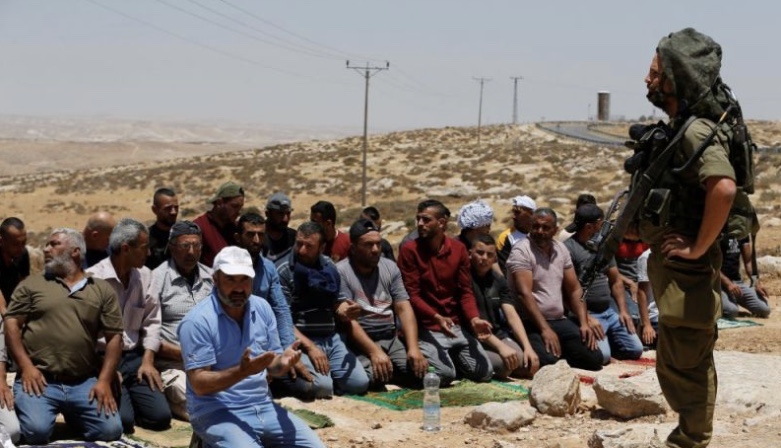
West Bank, The Indonesia Post – About 1,200 Palestinians living in the occupied West Bank are threatened with forcible transfer because their homes will become fire zones for Israeli soldiers.
A decade of legal battles led to last month’s defeat in Israel’s Supreme Court.
The Supreme Court ruling would prompt massive evictions, the largest since Israel seized the territory in the 1967 Middle East war.
But the settlers refused to move. They hope their resistance and international pressure will prevent Israel from carrying out expulsions.
“They want to take this land from us to build settlements,” said Wadha Ayoub Abu Sabha, a woman who lives in al Fakheit.
The Palestinians who inhabit the village work as shepherds and farmers. They claim to have an affinity with the place.
“We’re not leaving,” she said.
In the 1980s, Israel declared the area a closed military zone known as the “Firing Zone 918”.
They argued in court that the 3,000-hectare land along the West Bank boundary they occupied was “very important” for training activities.
They also say that the Palestinians living there are only seasonal residents.
“This has been a year of great sadness,” said Abu Sabha in a trembling voice as he sat inside one of the tents still standing lit by only one light bulb.
People in the area – part of the Southern Hebron Hills – live traditionally in underground caves. Over the last two decades, they have also started building tin huts and small spaces above ground.
The Israeli army has been destroying the huts for years, said Abu Sabha. Now, with court support, the expulsion looks like a matter of time.
Not far away, his family’s property has been turned into a pile of rubble after soldiers came with bulldozers to tear down the building.
She lamented the great loss he had suffered: the herd which had dwindled. To her, farm animals are worth more than broken furniture.
Many of the arguments presented during the trial centered on whether the Palestinians living in the area were permanent or seasonal residents.
The Supreme Court ruled that residents there “failed to prove their claim of permanent residency” before the area was declared a firing zone.
The decision was based on aerial photographs and excerpts from a 1985 book that both parties claim as evidence.
The book, entitled “Life in the Caves of Mount Hebron,” was written by Israeli anthropologist Yaacov Havakook.
He spent three years studying the lives of Palestinian farmers and herders at Masafer Yatta.
Havakook declined to comment and asked Reuters to read his book.
He said he had attempted to submit an expert opinion on behalf of residents there at the request of their lawyers.
However, he had been barred from doing so because at the time he was working for the Israeli defense ministry.
The United Nations (UN) and the European Union (EU) condemned the Supreme Court’s decision and urged Israel to stop the destruction and expulsion.
“The establishment of a firing zone cannot be considered as a ‘very important military reason’ for moving a population under occupation,” an EU spokesman said in a statement.
In a transcript of a 1981 ministerial meeting on settlements released by Israeli researchers, agriculture minister Ariel Sharon proposed that the Israeli military expand a training zone in the Southern Hebron Hills to expel Palestinians from their lands.
“We would like to offer you more training zones,” said Sharon, recalling “the spread of the Arab villagers from the hills towards the desert”.
Sharon later became prime minister of Israel.
The Israeli military told Reuters the area was declared a firing zone for “a variety of relevant operational interests”.
They also say that Palestinians have violated closure orders by constructing buildings without permits for years.
According to the United Nations, Israeli military authorities reject most Palestinian applications for building permits in “Area C”, an area that covers two-thirds of the West Bank.
In the area, Israel assumed full control and most of the Jewish settlements were established. Elsewhere in the West Bank, Palestinians have limited autonomy.
UN data also shows that Israel has marked nearly 30 percent of Area C as a military firing zone. The move risks forcibly evicting 38 of the most vulnerable Palestinian communities.
Meanwhile, Jewish settlements in the area continued to expand and further restricted the movement of Palestinians. Land for planting and grazing livestock is also getting narrower.
“All these olive trees are mine,” said Mahmoud Ali Najajreh from al-Markez, another hamlet in danger of being evicted, pointing at the grove of trees. “How can we leave?”
About 3,500 olive trees that he planted two years ago are starting to sprout.
“We will wait for the dust to settle, then build again,” said Najajreh.
“We’d rather die than leave here.” (mhn/bbs)





Comment