

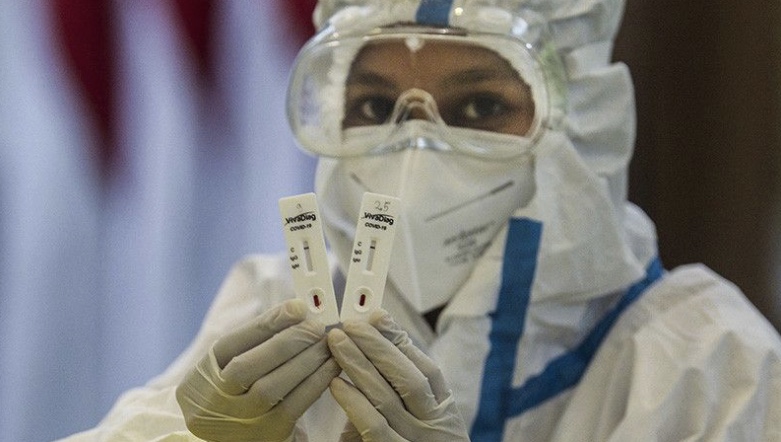
Jakarta, The Indonesia Post – Spokesperson for the Indonesian Ministry of Health, Siti Nadia Tarmizi, urged people with symptoms to be tested for COVID-19 immediately because the Omicron variant generally has mild symptoms but is still at serious risk and even triggers death.
“Although the symptoms shown are generally mild, the risk for serious illness and even death is still there,” said Nadia Tarmizi, who was confirmed by telephone in Jakarta, Sunday.
The statement answered the behavioral tendency of people who are symptomatic but are reluctant to carry out tests at health service facilities. The situation was triggered by the attitude of the people who still took the Omicron symptom lightly.
The Ministry of Health reported that the rate of testing for COVID-19 through the antigen test method and the rapid PCR test in the past week was less than 2.54 percent per week. In fact, in the period of July 2021, Indonesia recorded the highest test record in a number of provinces, an average of 50-90 percent.
Nadia said the target for COVID-19 tests per day at the population level in Indonesia reached 324,000 people.
For this reason, Nadia appealed to the public to know more about the potential for Omicron transmission through a number of symptoms that arise.
Reports from the Indonesian Lung Doctors Association (PDPI) on 17 Omicron patients at the Friendship Hospital in East Jakarta showed 63 percent dry cough, 54 percent sore throat, 27 percent colds, 36 percent headache and 18 percent fever.
According to Nadia, these symptoms can lead to serious illness and even death if the treatment is delayed. As of January 27, 2022, three Omicron patients have died.
The three patients came from the elderly group with comorbidities such as heart disease, diabetes, kidney failure and obesity. One of them has not received a COVID-19 vaccination, while the remaining two have received a full dose of vaccine and a booster or booster dose.
“We still urge the public to find out Omicron early so they can isolate themselves and avoid severe symptoms,” she said.
According to Nadia, early handling of Omicron can prevent transmission to others on a wider scale. “Because of the tendency of cases that are asymptomatic or with mild symptoms. This is not an incentive for the community to want to carry out examinations,” she said.
Nadia said a number of areas that need to increase testing include East Java, Central Java and Bali. “Like Yogyakarta, cases are still low, Bali is still low. But the capacity for ‘tracing’ is not yet maximized,” she said.
The Ministry of Health has also made various efforts by making regulations that lead to preventing the spread of COVID-19, one of which is imposing a level of restriction on community activities (PPKM) in each region.
The PPKM is accompanied by strict health protocols, namely wearing masks, maintaining distance, washing hands with soap, reducing mobility and staying away from crowds.
”These efforts are carried out consistently and are evaluated regularly so that every time there are additional cases with small or large numbers, proper treatment management is immediately carried out in the hospital,” she said.
In addition, the provision of facilities in hospitals, especially treatment beds, is provided to the fullest. Nationally, the Ministry of Health provides care beds in hospitals amounting to 120 thousand to 130 thousand.
Not only that, the Ministry of Health has also provided telemedicine services for self-isolated patients to reduce mobility. This service makes it easy for patients to do consultations to get free medicine. (mhn/bbs)


Comment