


Jakarta, The Indonesia Post – Labor leader Anthony Norman Albanese has become Prime Minister of Australia after defeating incumbent Scott Morrison in the general election on Saturday (21/5). Albanese, called Albo by his friends, appointed Penny Wong, the shadow Minister of Foreign Affairs of the Labor Party, as Australia’s top diplomat.
How is Australia’s foreign policy towards Indonesia and Southeast Asia under this new duo?
Historically, Australian Labor prime ministers have had a reputation for being more open to international engagement and engagement, particularly with Asia.
In 1971, Labor leader Gough Whitlam opened the door to Australia-China diplomatic relations with a breakthrough visit to Beijing. When Whitlam became prime minister, Australia became Asean’s first Dialogue Partner in 1974.
PM Bob Hawke initiated the 1989 APEC (Asia Pacific Economic Cooperation) cooperation. His successor, PM Paul Keating, increased the cooperation to a meeting of heads of state. At the 1994 APEC Summit, he and leaders of other countries produced the Bogor Declaration to strengthen regional trade. At that time, Indonesia-Australia relations became the most intimate in the era of President Soeharto. Proximity to Indonesia and priority attention to Asia was continued by other prime ministers of the Labor Party such as Kevin Rudd.
However, whatever party is in power, the foundation of Australia’s foreign policy will certainly not leave and even prioritize their alliance with the United States and Britain. This was proven when Prime Minister Julia Gillard, who is also from the Labor Party, in 2011, made a decision that unsettled many neighboring countries by allowing the deployment of US troops at the Darwin base. At that time, Albanese was Minister of Infrastructure and Transport in Gillard’s cabinet.
In the last year various statements by Albanese and Wong have shown the awareness of the importance of Indonesia’s role as a neighbor and primus Inter pares (the first among equals) in Southeast Asia.
In his speech at the National Press Club in Canberra (18/5/2022), Albanese said Indonesia would become a superpower, on par with China and India as giants in Asia.
In addition to economic cooperation, Albanese underlined the importance of strengthening people-to-people relations and partnerships in maritime security.
Albanese’s attention to Indonesia has been quite consistent and not just rhetoric. When he was a minister in Rudd’s cabinet, his first official visit was to Indonesia. Then Albanese’s first official visit as leader of the Labor Party was also to Jakarta in August 2019.
During his last visit, he met with Foreign Minister Retno Marsudi and discussed the need to strengthen the Indonesia-Australia Comprehensive Economic Partnership Agreement (IA-CEPA), as well as simplify the visa process for Indonesian and Australian tourists.
When asked by reporters about the issue of Papua, Albanese said that human rights must be respected in Papua. “We understand the longstanding bi-party commitment to Indonesia’s territorial integrity, and that’s understandable,” he added.
Speaking at the Lowy Institute in Sydney (10/3/2022) Albanese said that Indonesia and India would be a priority in strengthening their government’s bilateral relations later.
“We will work with Jakarta to realize an A$200 million environmental and infrastructure partnership, and the economic realization of the Indonesia-Australia Comprehensive Economic Partnership Agreement that has been promised but has yet to be implemented,” he added.
During his recently concluded election campaign, Albanese also said Indonesia would be the first country he would visit as prime minister. That intention may now be defeated because the Prime Minister of Australia is scheduled to attend the Quadrilateral Security Dialogue (abbreviated as Quad) on Tuesday (24/5/2022) in Tokyo involving his close allies in Asia Pacific – America, Japan and India.
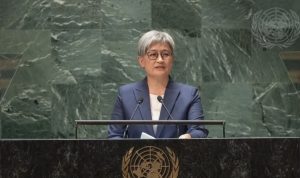
What about Australia’s new foreign minister? As a Malaysian born who settled in Australia when he was 8 years old, Wong should understand Indonesia and Southeast Asia.
As a virtual speaker at the Center for Strategic and International Studies (28/3/2022), Wong said that all countries in Asean were important, but underlined the priority of Indonesia.
“Obviously many countries in Southeast Asia are looking to deepen their relationship. But for Australian foreign policy makers, Indonesia has always been the center,” he said.
Wong in the discussion also criticized the Morrison government’s policies which were not conducive to strengthening bilateral relations.
“Unfortunately as we enter the pandemic, the government (Morrison) has cut development assistance for Indonesia in health support. We (Labor Party) will increase the assistance… although not immediately,” Wong promised.
In general, Indonesia can expect a lot from Australia’s new government. Various statements encourage optimism, and many agendas are in line with President Jokowi, such as strengthening economic cooperation, tourism, and climate change.
However, there are some things that we should be concerned about in the context of geopolitics.
Loud rhetoric is often displayed when talking about China.
Albanese in particular highlighted the China-Russia friendly partnership agreement which was declared last February. “There are many reasons for concern about the partnership, particularly in the context of China’s increasing assertiveness in our region.”
“China under Xi Jinping has demonstrated a more violent authoritarianism and outspoken nationalism,” Albanese said while speaking at the Lowy Institute. “That is why we are giving strong support to AUKUS (the alliance of Australia, UK and US), and ensuring that the Quad delivers results in the region.”
Wong conveys the same narrative. Several times he discussed the Pacific region not only as a development partner but also as Australia’s sphere of influence in containing China.
It is interesting that in the campaign debate between Wong and the incumbent Foreign Minister Marise Payne, the issue of the Pacific dominated and Indonesia was practically ignored.
Both Albanese and Wong also affirmed their alliance with the United States, the AUKUS alliance and their commitment to a defense budget of at least 2 per cent of Australia’s GDP as part of the policy pillar. This is in line with the previous government’s policy with the addition of Australia’s defense budget which rose 7.4 percent for 2022-2023, or around 2.1 percent of GDP.
What needs to be worried for Indonesia is the impact on the strategic environment of the Asian region which has the potential to continue to heat up if Australia’s position as America’s biggest ally in the Asia Pacific region continues to shriek against China.
Indonesia’s aspiration is to form an area free from superpower disputes. Indonesia does not want to be squeezed again like the Cold War era when countries in Asia became pawns in the feud.
Despite having the same goal, here is the main difference between Indonesia’s and Australia’s attitudes. Jakarta wants to create a peaceful and prosperous region through multilateralism without the domination of superpowers. While Canberra continues to prioritize their Western alliances and alliances.
But Albanese’s biggest homework early in his reign was how the new prime minister would transform Australia’s foreign policy infrastructure, which in recent years has been dominated by security agencies such as the NSC, and not the Ministry of Foreign Affairs.
Indonesia must be careful to see how Wong can strengthen his position as the main policy maker of Australia’s foreign policy.
The chaos with France regarding the cancellation of the purchase of submarines and the minimal consultation with Indonesia prior to the formation of AUKUS is a miscommunication that should not be repeated.
Thank you Mr. Scott. Congratulations to the Prime Minister of Albania. Similar but not the same. Substance or style and feel? We are waiting for you next week in Jakarta. (ojn/mhn/bbs)




Comment