

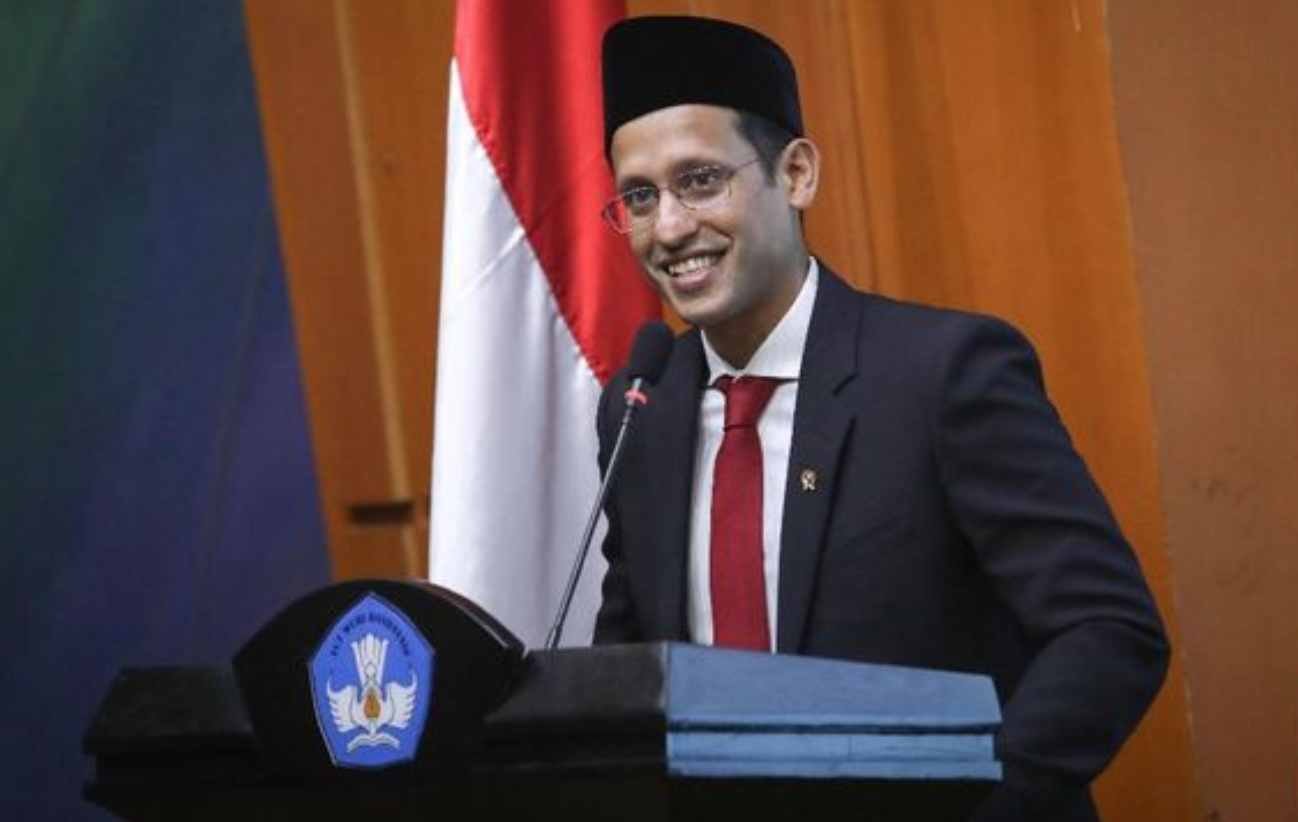
Jakarta, TheIndonesiaPost – Minister of Education and Culture (Mendikbud) Nadiem Makarim, said the COVID-19 outbreak brought a lot of wisdom to Indonesian education.
He said the pandemic gave teachers the opportunity to do online learning for the first time. This, said Nadiem, made teachers aware that learning could occur anywhere.
“The crisis is an extraordinary challenge for our country and the whole world. However, from this crisis, we get a lot of wisdom and learning that we can apply now and after,” Nadiem said in his speech at the National Education Day celebration ceremony held online at 08.00 WIB, Saturday (2/5).
Parents also become aware of the difficulty of the teacher’s task of teaching students effectively. He considered this to cause empathy from the side of parents to the teacher.
“Effective education requires effective collaboration from these three things, student teachers and parents. Without that collaboration, effective education is not possible,” he added.
Separately, the Federation of Indonesian Teachers Unions (FSGI) had a different view on education in the corona pandemic. FSGI stated that as many as 68,265,784 students and 3.2 million teachers were affected by the corona outbreak and had to teach from home.
FSGI assesses schools, teachers, students, parents until the local government is not ready to handle the challenges of education in the midst of a sudden outbreak. Students were also found to feel burdened by the distance learning method (PJJ) applied by the teacher. Teachers’ abilities are considered to be still minimal in managing online learning.
In addition, online learning is also said to be effective only in areas that have equitable internet access. While not all regions can provide internet access to all students and schools.
“Even electricity has not yet entered the region. So the teachers were forced to teach to come to the homes of students despite the potential to violate the PSBB and COVID-19 health protocol,” FSGI was quoted as saying by CNNIndonesia.
According to FSGI, PJJ’s policies which rely mostly on online learning have the potential to widen socio-economic inequality between students throughout the region.
For this reason, the government is encouraged to create educational scenarios in times of concrete crisis. This includes short-term, and long-term scenarios if a similar crisis strikes Indonesia.
“It is important to design an Emergency Crisis Curriculum. Because the condition of the community, parents, students, teachers, and educational supporting infrastructure is very limited,” said Deputy Secretary-General of FSGI, Satriwan Salim.
The Ministry of Education and Culture itself states that it is thinking about the PJJ scenario until the new school year 2020/2021. If the outbreak has not subsided yet, chances are PJJ can continue until the end of the year.
Until now PJJ has been conducted with various methods according to the ability of the school. Starting from online with an online learning application system, a messaging application.
Until the offline method with television and radio.
Whereas the technical case of the PPDB Ministry of Education and Culture submitted to each local government. The Ministry of Education and Culture encourages PPDB to be conducted online, or with a health protocol if there is no internet access. (ojan/bbs)


Comment