

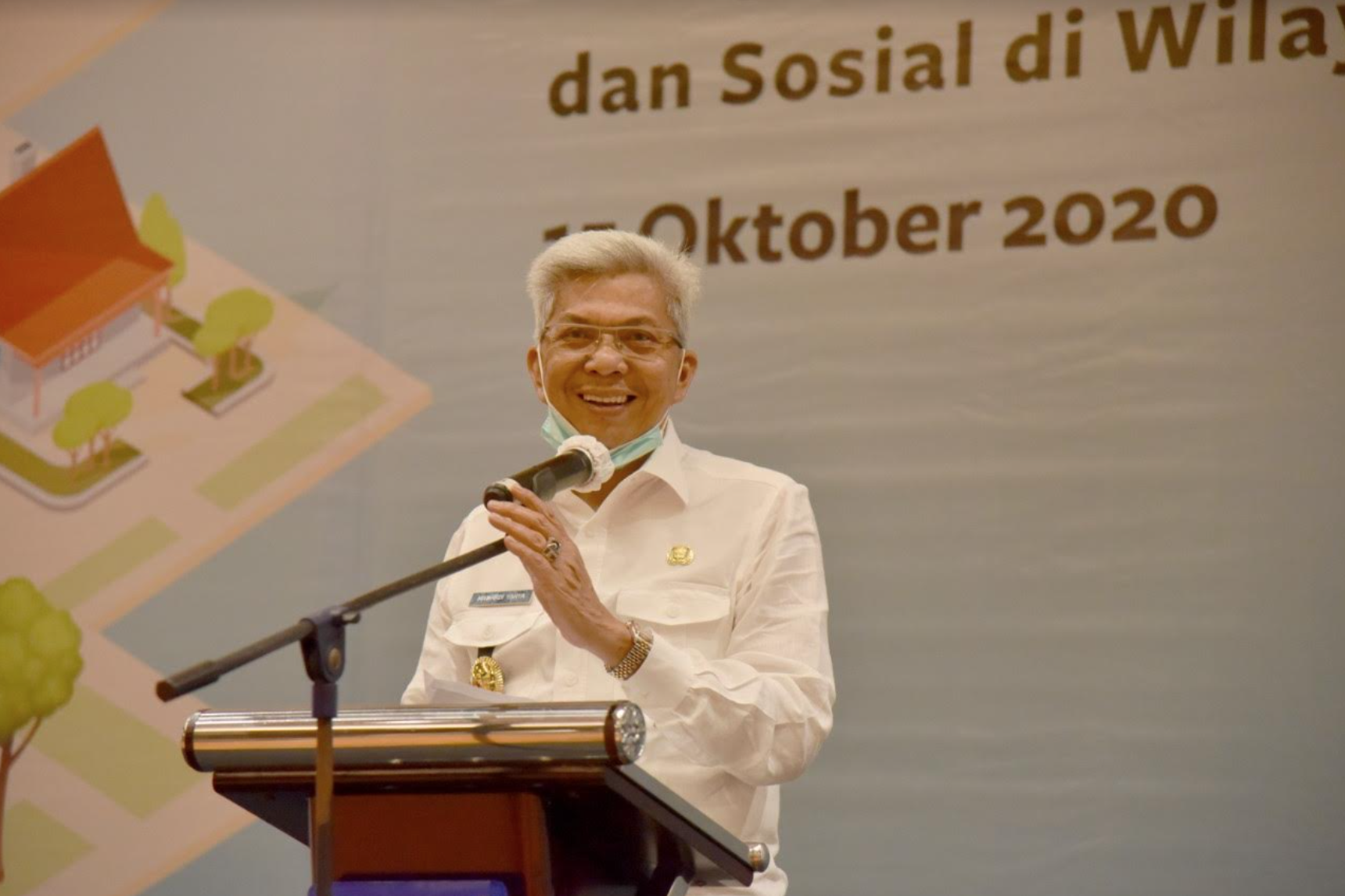
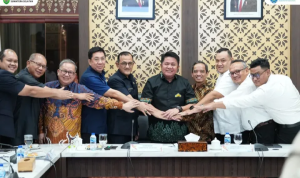
PALEMBANG, The Indonesia Post – Deputy Governor of South Sumatra H Mawardi Yahya asked that agrarian reform in South Sumatra be strengthened. This was conveyed when he attended and opened the public consultation on environmental and social aspects in the working area of the South Sumatra Agrarian Reform Acceleration Program (PPRA), at the Ballroom of the Novotel Palembang Hotel, Thursday (15/10).
Mawardi assessed that agrarian reform is able to overcome the obstacles that often arise. Both agrarian conflicts and land disputes in the community.
“This Agrarian Reform can narrow the imbalance in land control and ownership, which in fact will provide new hope for change and social and economic equality of society as a whole,” said Mawardi.
He believes, agrarian reform fundamentally provides programs that can solve the poverty problem of rural communities, improve welfare with national food self-sufficiency, increase land productivity, give recognition of land rights to the community legally.
“The agrarian reform program that is being carried out is of course to assist the community in obtaining certification for their land legally,” he said.
As a policy maker, he also asked parties related to agrarian services to continue to improve their performance.
“We as policy makers should not give up and the system needs to be improved gradually,” he said.
A similar sentiment was also conveyed by the Head of the Regional Office for Agrarian and Spatial Planning / National Land Agency of South Sumatra Province Pelopor.
He explained, this agrarian reform program will create agrarian justice while still paying attention to the impact it will cause.
“A very strategic step must be taken so that the implementation of agrarian reform in South Sumatra is fast. This will create agrarian justice,” he added.
It is known, there are three forms of agrarian reform, namely asset legalization, land redistribution and social forestry. In the form of agrarian reform which is targeted to be implemented in an area of 9 million hectares, as per the Attachment of Presidential Regulation Number 2 of 2005 concerning the 2015-2019 National Medium-Term Development Plan, in its scheme the legalization of assets of 4.5 million hectares includes legalization of transmigration lands that have not yet with a certificate covering an area of 600,000 hectares and legalization of lands already under community control covering an area of 3.9 million hectares.
For land redistribution of 4.5 million hectares, covering 400,000 hectares of land use rights, abandoned land and other State lands and lands originating from the release of forest areas covering an area of 4.1 million hectares.
The role of the Ministry of Agrarian Affairs and Spatial Planning / National Land Agency (ATR / BPN) in Agrarian Reform is to provide assets and access. In terms of assets, the Ministry of ATR / BPN guarantees legal certainty over the land owned, such as providing land certificates, accelerating land registration and inventory of control, ownership and use and utilization of land within the framework of agrarian reform carried out through the Complete Systematic Land Registration Program (PTSL). Regarding access, the Ministry of ATR / BPN provides empowerment for road and irrigation infrastructure, including post-harvest infrastructure, education and training, business credit, and marketing.
In 2018, the Ministry of ATR / BPN has a target of land certification through PTSL of 7 million fields and a target of land redistribution of 350,650 plots spread across 31 Provinces throughout Indonesia. Based on data held by the Ministry of ATR / BPN, PTSL using potential data as of June 7 2018, mapping of 2,077,139 fields has been carried out, as many as 519,759 certificates and the potential for PTSL as many as 915,911 fields.
During 2018 the Ministry of ATR / BPN has printed success stories of Agrarian Reform, including; The redistribution of ex-HGU lands that were voluntarily released in Siak, Riau amounted to 4,000 fields covering an area of approximately 4,000 ha, KT in the context of developing science and technology-based livestock on ex-HGU land covering an area of 510 ha in Soppeng, South Sulawesi, KT in the context of developing tourism areas on ex-HGU land covering an area of 47 ha in Pandeglang, Banten. Redistribution of ex-HGU land and abandoned land in North Sulawesi; 3,000 ha of cocoa village in Kolaka will be developed, East Kolaka: The release of HGU 6,070 ha and abandoned land 225 ha, Muna ex HGU 1,100 and 1,500 ha, IP4T has already been implemented. (jekk/ril)

Comment