

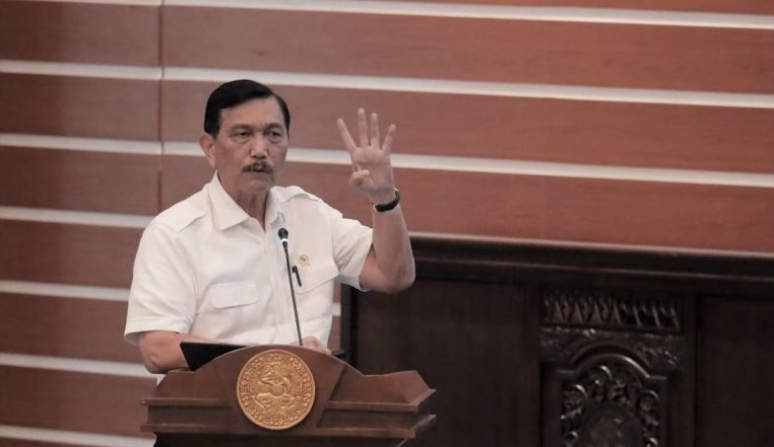
Surabaya, The Indonesia Post – Coordinating Minister for Maritime Affairs and Investment Luhut Binsar Pandjaitan explained the transformation of the Indonesian economy after the COVID-19 pandemic when he was a speaker at the fifth series of Leaders Talk for the Graduate School of Airlangga University Surabaya, Friday.
“Indonesia’s economy can still be resilient even though it is hit by COVID-19. In addition, the economy is still in line with the realization of Indonesia’s vision of becoming a developed country before 2045,” he said.
According to him, some of the factors for this resilience are the high vaccination rate and how Indonesia can take advantage of geopolitical dynamics for its benefit.
The second factor, he embeds in the context of the global economic impact of Russia’s conflict with Ukraine
“It is predicted that the average increase in Indonesia’s Gross Domestic Product (GDP) until 2045 is 5.8 percent per year. However, if Indonesia can answer global problems with transformative innovations, it is hoped that Indonesia can achieve an average GDP of 7.2 percent per year,” said Coordinating Minister Luhut.
He revealed that Indonesia under the leadership of President Joko Widodo is trying to expand the scope of the industry through downstreaming.
This, said Luhut, means that Indonesia does not only produce raw materials, but also produces processed products from these raw materials.
For example, said Luhut, the nickel industry has placed Indonesia as the world’s largest producer. Downstreaming this industry will equalize the center of the Indonesian economy so that it is not Java-centric.
“In the future, we hope to have a nickel battery industry that we produce and is useful for electric cars. Industrial control from upstream to downstream will reduce Indonesia’s export deficit. This is also in line with the spirit of green energy,” said the Java-Bali Social Restrictions (PPKM) Coordinator.
Coordinating Minister Luhut also explained that Indonesia would strengthen its infrastructure and digitization program in order to create a more efficient economy. There are several sectors of the economy that will be transformed into a digital world.
First, the integration of goods and services with domestic products. Second, the integration of ESDM management for optimizing state revenues. Third, the integration of domestic ports to optimize transportation.
“We will also build an underwater cable infrastructure that directly connects from the United States to Jakarta. It is no longer allowed for our internet to pass through Singapore to make it more efficient. We don’t want our nation to be dwarfed,” said Luhut.
Furthermore, he said that Indonesia’s energy sources are slowly transitioning from fossil-based fuel. Therefore, all the potential of renewable energy in Indonesia must be utilized as much as possible.
According to Luhut, Indonesia has the potential for renewable energy in the solar, geothermal, water and wind energy sectors. For this reason, Indonesia has committed to achieving carbon net zero per year 2060 or sooner.
“We are also blessed with forests and mangroves that are large and capable of storing large amounts of carbon. That sector can be used for storage that is useful for carbon trading,” he said.
The blueprint for post-pandemic economic transformation, Luhut added, can only be realized with quality human resources.
According to him, Indonesia has a lot of potential in human capital, but the quality of education that has not been addressed is an inhibiting factor.
Therefore, Indonesia has provided a lot of scholarships and collaborations for Indonesian higher education with foreign countries, especially in the field of science so that the quality of human resources can be amplified. (ojn/bbs)

Comment