

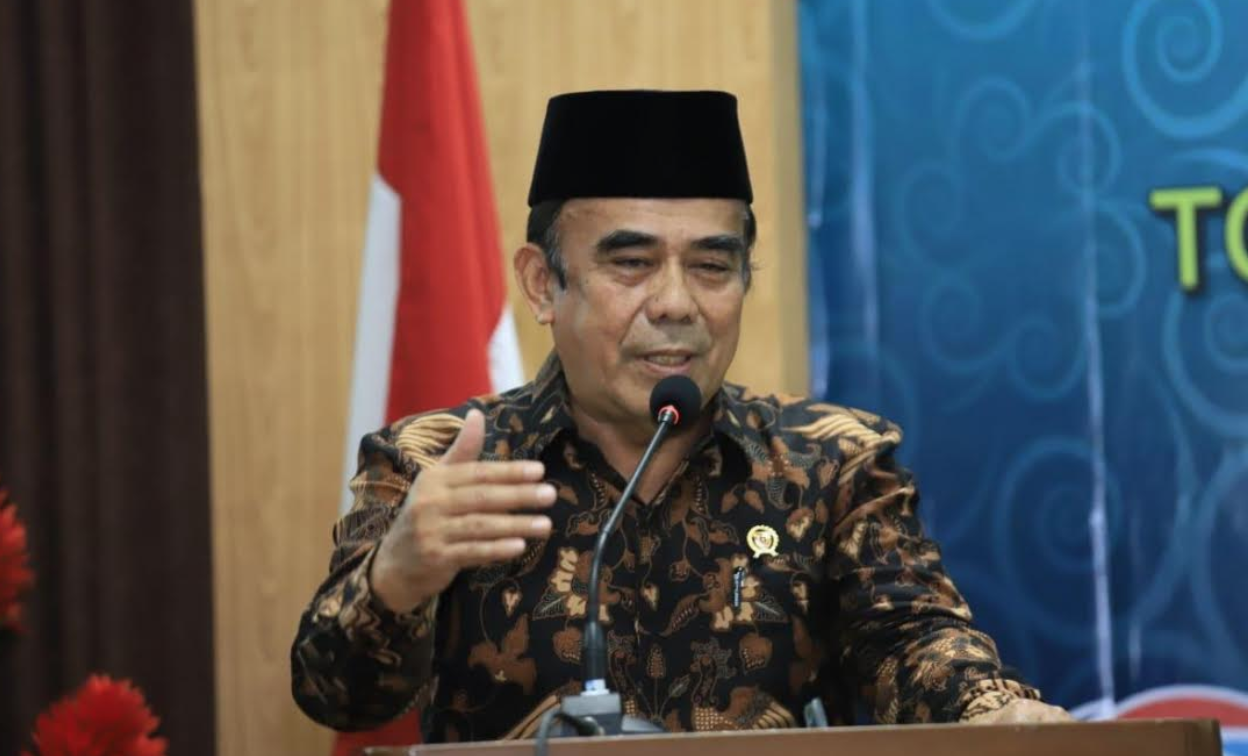
JAKARTA, The Indonesia Post – Fasting Ramadhan 2020 will arrive soon, but the Corona Virus 2019 (Covid-19) is still endemic. Regarding this matter, the Ministry of Religion of the Republic of Indonesia issued a circular letter as a guide to the worship of Ramadhan and Eid Al-Fitr 1 Shawwal 1441 H which was registered tarawih, dawn on the road, and breaking the fast together.
Circular Letter No.6 year 2020 signed by the Minister of Religion Fachrul Razi, sent to the Head of Provincial Offices in Indonesia, the Office of Ministry of Religion in Regencies / Cities in Indonesia, and Heads of Technical Implementation Units (UPT) throughout Indonesia.
“In the midst of the Covid-19 pandemic, the government through the Ministry of Religion gave a circular on worship guidelines that are in line with Islamic Sharia. The guide also explained steps to prevent, reduce the spread and protect employees and the Muslim community in Indonesia from the risk of Covid-19, “said Minister of Religion Fachrul Razi.
In the letter, continued Fachrul, the Ministry of Religion also provided guidance on the collection and distribution of zakat, tarawarih guidelines that are permitted and prohibited in mosques, as well as the issues of sahur on the road and ifthar jama’i (iftar together). “Sahur on the streets and breaking fast together are also regulated,” Minister Fachrul said.
However, continued the Minister of Religion, all the guidelines in the Circular he made can be felt if there is an official statement from the Central Government for the entire territory of the Republic of Indonesia, and / or by the Regional Government for their respective regions, for example on the grounds that are safe from Covid-19. “So, if there is an MUI fatwa and the government when approaching Ramadan and Eid al-Fitr, this circular can be ignored,” said Fachrul. (Asm / ray / bbs)
The guiding points in the Minister of Religion Circular Letter No. 6 of 2020, are as follows:
1. Muslims are required to perform fasting in the month of Ramadan properly based on the provisions of the fiqh of worship;
2. Sahur and breaking the fast are carried out by individuals or nuclear families, no need to eat on the road or ifthar jama’i (breaking the fast together);
3. Tarawih Prayers are performed individually or in congregation with the nuclear family at home; 4. Recitation or tadarus Al-Qur’an is done in their respective homes based on the command of the Prophet Muhammad to illuminate the house with recitations of the Qur’an;
5. Breaking the fast together whether carried out in government agencies, private institutions, mosques and mushala abolished;
6. Commemoration of Nuzulul Qur’an in the form of tabli by presenting large numbers of lecturers and masses, both in government institutions, private institutions, mosques and prayer rooms;
7. Not doing iktikaf in the last 10 (ten) nights of Ramadan at the mosque / mosque;
8. The Eid Al-Fitr Prayer which is usually held in congregation, both in the mosque or in the field is eliminated, for this reason the issuance of the MUI Fatwa is expected ahead of time.
9. In order not to carry out activities as follows: a) Tarawih praying around (tarling);
b) Estimating around. Takbiran activities are sufficiently carried out at the mosque / mosque using loudspeakers;
c) Pesantren Kilat, except through electronic media.
10. Hospitality or halal bihalal which is commonly carried out during Eid al-Fitr, can be done through social media and video calls / conferences.
11. Collection of Zakat Fitrah and / or ZIS (Zakat, Infaq, and Sadaqah):
a) Appeals to all Muslims to pay their zakat soon before Ramadan fasting so that it can be distributed to Mustahik faster.
b) For Zakat Management Organizations to minimize the collection of zakat as much as possible through physical contact, face to face directly and open outlets in crowded areas. This was changed to the socialization of zakat payment through zakat pickup services and banking service transfers.
c) Zakat Management Organization communicates through zakat collection units (UPZ) and Zakat Fitrah Collecting committees within the mosque, musala, and other zakat collection points within the community to provide facilities for hand washing with soap (CTPS) and cleaning tools disposable (tissue) in the environment.
d) Ensuring units at the Zakat Management Organization, mosque, musala and other places to clean the room and receiving zakat routinely, especially door handles, light switches, computers, keyboards (keyboards), recording devices, storage facilities and other facilities which is often held by the hand. Use staff who are skilled at carrying out cleaning tasks and use cleaning agents that are appropriate for these needs.
e) Remind the Zakat Fitrah and / or ZIS Collecting Committees to minimize direct physical contact, such as shaking hands when giving alms.
12. Distribution of Zakat Fitrah and / or ZIS (Zakat, Infaq, and Sadaqah):
a) Zakat Management Organization, Zakat Collecting Unit (UPZ) and Zakat Fitrah Collecting Committee and / or ZIS within the mosque, musala and other zakat collection points within the community to avoid the distribution of zakat fitrah to Mustahik through exchange of coupons and holding gathering of people.
b) Zakat Fitrah Management Organization and / or ZIS within the mosque, musala and other zakat collection points located within the community to avoid the distribution of zakat fitrah to Mustahik through coupon exchange and collecting recipients of zakat fitrah.
c) Zakat Management Organization, Zakat Collecting Unit (UPZ) and Zakat Fitrah Collecting Committee and / or ZIS who are in the mosque, prayer room and other zakat collection points within the community to distribute by giving directly to Mustahik.
d) Zakat Management Organization, Zakat Collecting Unit (UPZ) and Zakat Fitrah Collecting Committee or ZIS within the mosque, prayer center and other zakat collection points within the community to be pro-active in conducting Mustahik data collection in coordination with community leaders and the Chairperson Local RT and RW.
13. Officers who distribute zakat fitrah and / or ZIS to be equipped with health protective equipment such as masks, gloves and disposable cleaning tools (tissue).
14. In carrying out the worship of Ramadan and Shawwal, each party should encourage, create, and maintain the conduciveness of religious life by continuing to promote ukhuwah islamiyah, ukhuwah wathaniyah, and ukhuwah basyariyah. 15. Always pay attention to the instructions of the Central and Local Governments, regarding the prevention and handling of Covid-19.


Comment