

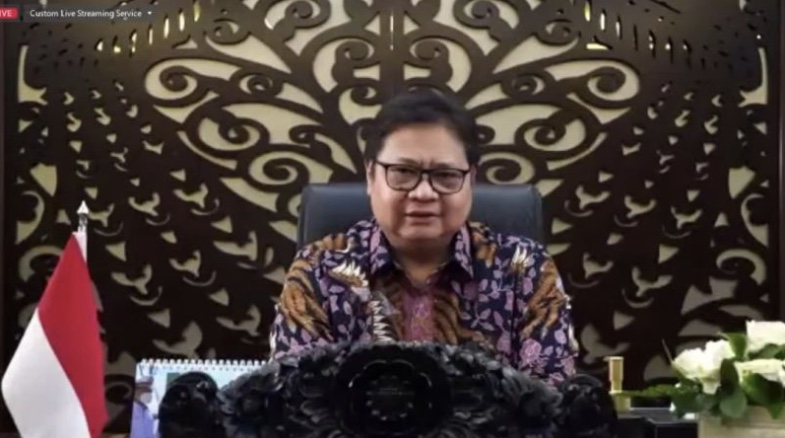
Jakarta, The Indonesia Post – Coordinating Minister for Economic Affairs Airlangga Hartarto said standardization and accreditation were needed to maintain the quality of Indonesian production so that they would be more competitive in the global market.
“Accreditation can increase the competitiveness of goods and services in the international market. This is in line with the direction of the President and Vice President, namely to increase productivity so that the Indonesian nation can advance and develop like other Asian countries,” said Airlangga at a meeting of the Standardization Body National (BSN) and the National Accreditation Committee (KAN) as quoted from an official statement in Jakarta, Thursday.
Standardization and accreditation also play a role in supporting government targets in integrating strategies, planning, and policies to increase economic growth and environmental sustainability as set out in the Sustainable Development Goals (SDGs).
In line with that, in an effort to recover the national economy, the Government of Indonesia is committed not only to restore economic conditions as before the crisis, but also to a better condition, one of which is by implementing a circular economy.
“Circular economy is not only about waste management but also how to design raw materials, product designs, and production processes so that raw materials and products produced can be recycled and have a longer use cycle,” said Airlangga.
In Indonesia, the circular economy concept has become part of the government’s policy, which among others is applied in the low-carbon development concept as stated in the 2020-2024 RPJMN and the 2030 Indonesia NDC Achievement Roadmap.
Airlangga views the circular economy should not only be implemented in government policies, but also implemented by all parties including the business world because export destination countries have started to implement various requirements related to sustainability.
“In several studies and scenarios of applying the circular economy principle, if we start now in five priority sectors, then in 2030 this circular economy can increase GDP to IDR 638 trillion in 2030, create new jobs, reduce CO2 emissions by up to 126 million tons. , and save water use of up to 6.3 billion cubic meters,” concluded Airlangga. (ojn/bbs)



Comment