

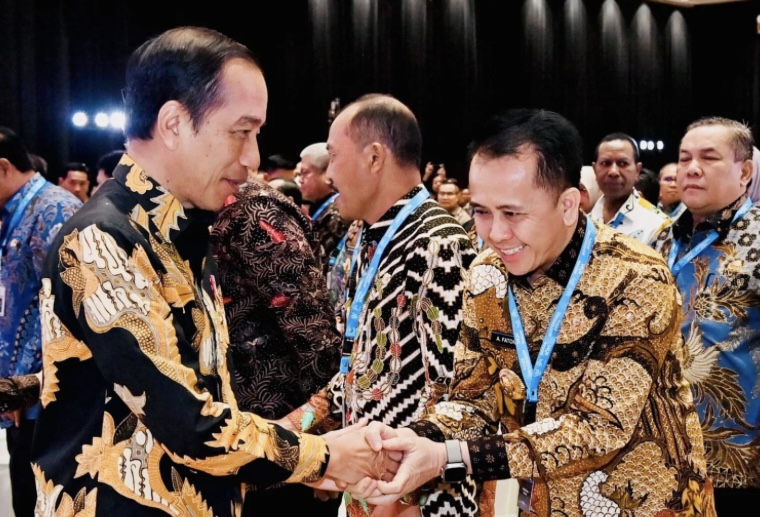
Palembang, The Indonesia Post – Acting (Acting) Governor of South Sumatra Agus Fatoni attended the 2024 National Development Planning Conference (Musrenbangnas) in order to refine the Initial Draft of the 2025 Government Work Plan held by the Ministry of National Development Planning/National Development Planning Agency at the Jakarta Convention Center Convention Center, Jakarta, Monday (6/4/2024). This Musrenbangnas was also attended directly by the President of the Republic of Indonesia (RI) Joko Widodo.
On the sidelines of the 2024 Musrenbangnas, Fatoni conveyed the importance of synchronization between the center and the regions. According to Fatoni, synchronization according to President Joko Widodo’s direction can come from the center and can also come from below (regional).
“In these two directions, then in the middle we hold deliberations. So the Musrenbang discusses planning from above (central) and planning from below (regional). “We must synchronize planning from below with policies from above,” he explained.
Specifically in South Sumatra, said Fatoni, the Provincial Government together with the Regents and Mayors throughout South Sumatra have held discussions and together are committed to strengthening central and regional synchronization.
“For South Sumatra, it is in accordance with the planning at the center. “We just have to monitor and ensure the details,” explained Fatoni.
Meanwhile, in his direction, the President of the Republic of Indonesia (RI), Joko Widodo, said that currently Indonesia is faced with a situation that is not easy and challenges that are not easy. Global economic growth is estimated to only grow 3.2%, the impact of the consequences of Covid are still being felt today. In fact, several countries have entered a recession, Japan, England and several European countries are in a position towards a recession.
Therefore, Jokowi reminded everyone to prioritize prudence in fiscal management, budget management and to really be prudent so that not a single rupiah of money misses the plans that have been made. He also reminded everyone
pay attention to the priority scale.
Jokowi further said that currently all countries are afraid of three things, firstly oil prices and loan interest because once loan interest rises, the fiscal burden will be very large. Therefore, all parties are advised to be careful in managing the existing budget.
“We have long-term development plans and medium-term development plans and each year we each have a government work plan or RKP. But what is not yet is whether it is in sync or not, with the big plans that we have. “This is not yet the case, therefore synchronization is key,” explained Jokowi
Jokowi gave an example, the central government built a dam, rebuilt primary irrigation, but secondary tertiary irrigation to the rice fields was not carried out so that the water did not reach the existing rice fields.
Then the Ministry of Transportation built a port, but the road that was supposed to be built by the regional government to get to the port, even though it was only short, was not built, so it became out of sync, out of rhythm.
” Everything must be synchronous and inline. everything in line from the Ministry to the area must be in line, therefore I want to remind the Ministry that if it has a plan, it must be submitted to the area where it wants to be placed. “Knock on the door, kulon nuwun, are we ready or not to build reservoirs, but if the area can’t afford secondary tertiary irrigation, move it to another province,” he explained.
Furthermore, Jokowi also said that the synchronization of the preparation of the 2025 RKPD must be based on principles. First, you have to be in line, you have to be in rhythm, don’t let the center go to the right, the area goes to the left, which can result in losing all plans.
According to him, everything has to be in line, it has to be in sync. For example, if the center wants to increase food production, the regions instead convert rice fields for property which is not in sync. Then secondly, the program must be results-oriented, it must have economic value, therefore it must be focused.
“Don’t go back and forth. I say that the budget is distributed to the government agencies, everything is not there and the priority scale is not clear. Don’t let the budget be used for too many meetings and many comparative studies. That’s the past, the future, don’t let it happen again. The third program must be right on target and strategic, meaning APBD, APBN, the benefits are really visible, don’t let it happen. I saw that the budget for stunting at the Community Health Center was given to the Community Health Center, so it became a fence for the Community Health Center.
Previously, the Minister of National Development Planning/Head of Bappenas, Suharso Monoarfa, said that in the last decade, Indonesia had achieved significant progress in various fields of development amidst global domestic dynamics due to geopolitical economics and Covid-19.
During the administration of President Joko Widodo, he said that economic growth was stable and maintained at around 5%, poverty fell to single digits (March 2014) 11.25% to 9.36% in March 2023. The provision of employment also increased annually by almost 3 times from 1 .87 million people in 2014 to 4.55 million in 2023, equitable development also shows a positive trend with a decrease in the Gini ratio from 0.406 in March 2014 to 0.388 in March 2023.
Apart from that, the farmer’s exchange rate increased from 102 in 2014 to 112.46 in 2023. Likewise, the quality of human resources also showed significant progress. The human development index rose more than 5 points from 68.9 in 2014 to 74.9 in 2023.
“We should be proud that Indonesia managed to reach the upper middle income category in 2019, slightly down then in 2020 we reached 4,095 USD capita and furthermore, over the last 13 years, Indonesia’s nominal GDP has almost doubled from 0.75 trillion USD to 1.4 trillion USD in 2023.
In the 2024 Musrenbangnas activities, awards were also given to Regional Development Award Winners (PPD), Presentation of the PPD Cup by the President of the Republic of Indonesia, and a visit to the Regional Development Expo by President Joko Widodo. Then in session II, a briefing from the Minister of National Development Planning (PPN)/Head of Bappenas, a briefing from the Minister of Finance, a briefing from the Minister of Home Affairs and a discussion on the alignment of central and regional planning in the transition period.
Meanwhile, the Governor of South Sumatra, Agus Fatoni, appeared to be present accompanied by Assistant I for Government and Social Welfare of the South Sumatra Provincial Government, Edward Chandra and the Head of the South Sumatra Provincial Bappeda, Regina. A. (ojn/ril)

Comment