

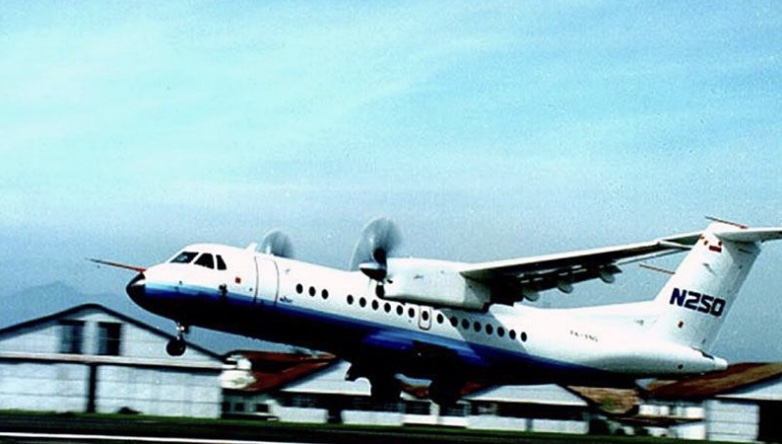
Jakarta, The Indonesia Post – That morning, August 10, 1995, the city of Bandung witnessed the history of the successful inaugural flight of a passenger plane designed by the nation’s children with the latest avionics technology of its time, fly by wire. The N-250 PA-1 Gatotkoco aircraft has placed Indonesia in a handful of countries in the world that are able to design and build high-tech products independently.
The efforts of 20 years of hard work have paid off and August 10 every year is then commemorated as National Technology Awakening Day (Hakteknas).
Through the philosophy of “Starting at the End, Ending at the Beginning”, or “Reverse Engineering”, the development of science and technology and national innovation is spurred. This philosophy, which was architected by BJ Habibie, and described in four stages of technological transformation that can be applied in various types of industries in Indonesia. The goal is to meet domestic needs first and create jobs, then export.
Habibie’s background as an engineer certainly needs real proof. It was here later that the above concept was realized in the development of the aircraft industry in the country, an industry that he was very good at and hoped to be able to replicate in other industries in the country.
Phase I of the technological transformation includes manufacturing the aircraft on an assembly line under license and producing the CN-212 Aviocar transport aircraft and the NBO-105 Bolkow helicopter. At this stage, domestic engineers and technicians have begun to master aircraft technology and have earned income through accumulated working hours.
Then, phase II of the technological transformation began by providing added value and cramming local content into technological products made, as well as increasing the number of domestic working hours for each product produced.
The CN-235 Tetuko aircraft appeared and Indonesia also began to be able to make larger size helicopters of the NAS-332 Super Puma type. Phase I and Phase II technology products have also entered the market, both domestic and export.
Phase III of the technological transformation is directed at manufacturing industrial products with a full engineering process carried out by domestic engineers and technicians independently.
Through the integration of the system and the design and development of the latest technology, the N-250 Gatotkoco aircraft emerged, which was the most sophisticated commuter aircraft in its class at that time, including the “fly by wire” control system, which at that time was only applied to passenger planes with engines jet.
Phase IV technological transformation begins soon. Here, various basic research and applied research are excited to produce new products that are superior, with more advanced technology and create more job opportunities.
The dedication of scientists
In the aircraft industry, stage IV of the technological transformation will be realized in the N-2130 aircraft product. Unfortunately, the multi-dimensional crisis that led to the 1998 Reformation occurred in Indonesia.
The CN-250 Gatotkoco aircraft project, which will soon enter the production stage, must be stopped according to the Letter of Intent signed by Indonesia – the International Monetary Fund (IMF). The technological transformation process stopped and Indonesian aviation engineers, who were already very capable, had to find work in the aviation industries of France, the US, Canada and Brazil. Brain Drain has occurred.
Then, what about the future? Indonesia is projected to become a developed country during the 100th Indonesian Independence Day, August 17, 2045, and enter the top 5 world economic powers. Consultant Mckinsey (2012) projects that Indonesia will jump from the current No. 16 World economic power to the No. 7 World economic power in 2030, provided it has the prerequisites for the availability of qualified human resources and a middle class of 135 million people.
We must upgrade to a high-income country. We don’t want to be trapped in: “The Middle Income Trap”, or the “Trap of Middle-Income Countries”, where the economic growth is only modest but the economic growth is directly absorbed back into domestic economic consumption. There are not enough resources available to invest to jump into the high-income group of economies.
“Engineers and Innovators Create Wealths”. This is where the role of engineers, engineers and innovators to bring up monumental works. The presence of the N-250 Gatotkoco aircraft proves that we can.
All types of development must continue to pay attention to the percentage of local content, both at the feasibility study stage, the detailed engineering design stage, the component procurement stage to the construction stage (Engineering – Procurment – Construction, EPC). As much as possible, domestic capabilities should be mobilized.
Of course, it takes sides and protection from the Government. Do not let all activities be handed over to foreign consultants just because the project budget comes from foreign debt. There must be incentives for engineers, researchers and science and technology actors in the country.
For engineers and innovators, don’t give up. Science and technology products and innovations are needed by the wider community. A more creative approach is needed, including marketing these products through the LKPP e-catalog which can certainly be absorbed by various government institutions both at the central and regional levels as well as SOEs, without tenders.
Various collaborations with the village government need to be made and Village-Owned Enterprises (BUMDes) are formed so that the distribution of government funds to villages can be useful and effective with the support of science and technology and innovation.
This is the field of dedication of scientists, engineers and innovators to build a country with a warrior mentality and spirit, as has been passed down by our predecessors through their real works, including building the N-250 Gatotkoco airplane independently.
*) Indroyono Soesilo is Coordinating Minister for Maritime Affairs in the Working Cabinet (2014-2015) (mhn/bbs)


Comment